
India-China relations have always attracted Parliament's attention and there have always been useful and productive and constructive discussions how to engage with China, notes Rup Narayan Das.

China on Monday said Indian Prime Minister Manmohan Singh's three-day visit from Tuesday is of great importance for deepening strategic partnership amid expectations that the two sides would sign some key pacts, including one to prevent incursions along the LAC.

General Zhao Zongqi is well known in India for having commanded the Chinese troops during the Dokalam episode. Zhao knows every inch and corner of the Indian border, at least the Eastern and Central sectors, including the Naku La area which witnessed fist-fights between Indian and Chinese troops in April/May. Claude Arpi introduces us to the PLA generals masterminding the Chinese aggression in Ladakh.

'How can one bring jihad into a relationship? How can one be restricted on the grounds of religion in marital things?'
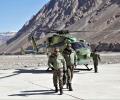
'This reluctance to respond forcefully to Chinese PLA provocations and outright aggression has as much to do with Prime Minister Modi personally, as with the institutional mindset of the MEA or even the Indian Army.' 'They are scarred by the 1962 War and are still cowed by China.'

Until Delhi and Beijing resolve outstanding border issues within an accelerated time frame, standoffs like Doklam will be repeated across various peaks along the Himalayas, says Mathew Maavak.

This is the first time Pakistan and Kashmir have been brought into the narrative.

'Open conflict would be a disaster for both China and India.'
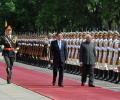
'Prime Minister Narendra Modi appears to have gone beyond the cautious approach usually advocated by the tightly-knit 'China group' in the ministry of external affairs in dealing with Beijing.'
'Prime Minister Narendra Modi appears to have gone beyond the cautious approach usually advocated by the tightly-knit 'China group' in the ministry of external affairs in dealing with Beijing.'

Major General Sujan Singh Uban, a legendary veteran of the Second World War, was a natural choice to raise, train and command the Special Frontier Force and mould them into a well oiled fighting machine, recalls his son Inspector General Gurdip Singh Uban (retd), who led SFF troops during the Kargil War.
India has experienced hands and will emerge with flying colours, declares Inspector General Gurdip Singh Uban (retd).

However, Denmark said it is difficult to conclude on the real intention behind this.

'Does the Indian army's new assertiveness risk a clash escalating into shooting and possibly skirmishes?' asks Ajai Shukla.

'Chinese troops are not geared to fight Indian troops who are battle hardened and acclimatised and are far more hardy.'
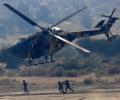
'Given the present force levels, India cannot fight and win.' 'India can't hope to terminate the conflict on India's terms and impose the nation's will upon the adversaries,' says Brigadier Gurmeet Kanwal (retd).

'I want to assure this House that in these talks we have not conceded anything.' Full text of what Defence Minister Rajnath Singh told Parliament on the Chinese pullback in eastern Ladakh.

Nevertheless, border dispute will feature prominently on Modi's agenda but the matter won't be discussed at length. Nayanima Basu reports

Modi's arrival has changed the optics of the visit. There is a different demonstration of the confidence level in the Indian leadership, but not much has changed beyond that, reports Sheela Bhatt/Rediff.com.
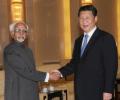
Vice President Hamid Ansari on Monday held talks with Chinese President Xi Jinping and conveyed the new Indian government's interest in furthering bilateral ties, even as he flagged off India's concerns over border related issues during his parleys with the top leadership in Beijing.

Outlining eight "pillars" for the future of India-China relations, President Pranab Mukherjee on Wednesday underlined the need for comprehensively resolving challenges including the boundary question through "political acumen" and "civilisational wisdom".
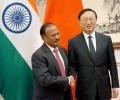
The decision was taken during the annual 19th round of boundary talks in Beijing between National Security Advisor Ajit Doval and his Chinese counterpart Yang Jiechi.

One thing Beijing must understand is that India is not obsessed with being a threat to China but only wants a rightful place for itself in the world, says Sanjeev Nayyar.

'China is concerned about its impact within Tibet.'

Both India and China have realised that if border incursions keep reoccurring, other issues of mutual interest will remain unstable. Sheela Bhatt reports
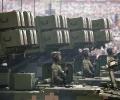
The first priority for the new Tibetan administration in Dharamsala should be to look at Tibetan recruitment in the PLA, suggests Claude Arpi.
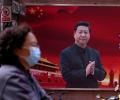
China has not limited the 'battle' to the diplomatic field alone; the People's Liberation Army has become aggressive on the ground too. The recent 'fights' in Northern Sikkim and Ladakh are part of the pattern, asserts Claude Arpi.

Modi, who is undertaking his first visit to China as prime minister, will reach the ancient city of Xi'an, the home town of President Xi Jinping, for a summit meeting, an unusual departure from normal protocol and seen as a reciprocal gesture by the Chinese leader who was hosted by Modi in Ahmedabad when he visited India in September last year.

'China any day would prefer to team up with India and dump Pakistan once the resolution of the border dispute becomes an accomplished fact.'

'Whenever you roll out: effectiveness is important, operational logistics are important, side effects are important and vaccine hesitancy is important.'

The bravado of NDA ministers may have undone the gains made in cross-border security cooperation over the past several years.
'India and China have to make concrete progress with regard to the border issue, addressing the trade deficit, and facilitating people-to-people interactions. This has to happen in the next two, three years.' China expert Tansen Sen tells Sheela Bhatt/Rediff.com how India and China can take their relations to the next level.

Indian intelligence agencies have often claimed that left-wing extremists are trying to make inroads in the militancy-hit regions of north-east to foment further unrest. But Jaideep Saikia, noted terrorism and conflict analyst, claims, "People who speak of Maoism taking roots in the north-east have not read history".

'Chinese leaders rarely receive their foreign guests in cities other than Beijing. Such respect for India!' 'Does it mean that Modi could replicate "the warmth and unconventional way" by sending Indian troops into Tibet, as Xi did in Chumur (Ladakh) when he arrived in India? Of course, Indians are far too polite to do so,' says Claude Arpi.

Do Modi's foreign visits actually serve India or they nothing more than expensive tools for domestic positioning and image-building, asks Shehzad Poonawalla.
The second and final part of former cabinet secretary Naresh Chandra's interview to Sheela Bhatt.

'He was believed to finish his own work in an hour and spend the remainder of the time walking from one office to another, sitting down with the harried junior staff and helping them sort out the problems they were working on.'
 © 2026 Rediff.com - Advertise with us - Disclaimer - Privacy Policy - Sitemap - Feedback - About us - Terms of use - Grievances